The key takeaway for DMOs isn't that everything has changed; it's that these fundamentals now need to show up in the ways a younger, digitally native audience expects to engage.
Safety Becoming a Top Priority for Meeting Planners
When it comes to this cohort’s anticipated changes to the meetings industry, safety is clearly top of mind: 65.6% of planners expect the importance of destination safety to increase (which includes security measures undertaken by officials). In addition, 61.5% have reconsidered a destination due to a controversial issue in 2025—up 12.2 points year-over-year.
These controversies are varied: Protests and social unrest (46.2%), gender and racial equality concerns (45.1% and 45.0%, respectively) and general political reputation (44.9%) were among the most frequently cited reasons to reconsider a destination. What connects these issues is a broader understanding of safety than in the past. Meeting planners aren’t just concerned about physical risks; they’re also concerned about how safely their attendees will feel being their authentic selves within a destination.
Recent political events have certainly impacted events that invite international attendees, as 65.1% of respondents say that inbound international attendance is down. Moreover, 70.6% say the visa integrity fee introduced in mid-2025 is reducing willingness among international attendees to attend meetings in the U.S., while 75.1% have expressed concerns about holding meetings outside of the U.S. due to re-entry worries. The ability to easily and safely travel to and from a destination for a meeting or event has become a real concern for meeting attendees and planners alike.
The bottom line: Safety means different things to different planners—physical security for some, welcoming environments for others—and DMOs should be prepared to speak to different aspects of destination safety.
Start by asking your planner clients and prospects directly what safety means to them and their attendees, then tailor your pitch to address the heart of their concerns. Here are just a few ways you can showcase your destination’s safety:
- Testimonials from recent event planners that specifically call out the region’s safety (53.9% of planners selected this as a favored tactic)
- DMO representatives engaging in direct conversations with planners about their safety initiatives (favored by 48.8%, which is up 9.1 points YOY)
- Ambassador programs geared toward helping visitors navigate the destination (favored by 44.9%).
More than anything else, planners appreciate when DMOs provide a communications outline for emergency planning ahead of time, rather than waiting until an emergency happens. It goes a long way when planners know who to contact at the DMO and can feel secure that there's a contingency plan already in place.
The Rise of Second- and Third-Tier Destinations
We've also seen rising interest in second- and third-tier destinations. More than half of respondents said that this trend is fueled by the new experiences, perceived safer environments and better rates offered by these destinations. This shift means real opportunity for smaller markets, but DMOs need to fill in perception gaps to ensure that planners know all about the great opportunities within these markets.
Guest panelist Luke Wiggins, Vice President of Sales for Destination Rogers in Arkansas, mentioned his own such experience during our panel. Survey data showed that Rogers rated quite low on walkability to attractions from the city’s convention center—but they have a large concert venue next door to the center, as well as shops, restaurants and even a Topgolf nearby. Learning that the perception didn’t match the reality gave the DMO the opportunity to correct planner misconceptions about the Arkansas city.
Ultimately, if you’re a smaller or lesser-known destination, the demand is certainly there—but you need to proactively tell your story so that misconceptions don’t have the chance to grow. This is where DMO storytelling, FAM trips or planner ambassador programs become essential rather than nice-to-haves.
AI Makes the Human Connection More Valuable, Not Less
At first, we were surprised to see that the number-one desirable destination attribute for planners was technology, given the recent cultural anxiety over the rise of AI. But it makes sense when you hear how planners are thinking about it. One planner shared: "We see hybrid meeting technologies, AI-driven personalization and immersive tools as having the biggest impact. These trends will enable more inclusive participation, improve engagement and provide deeper insights through data analytics."
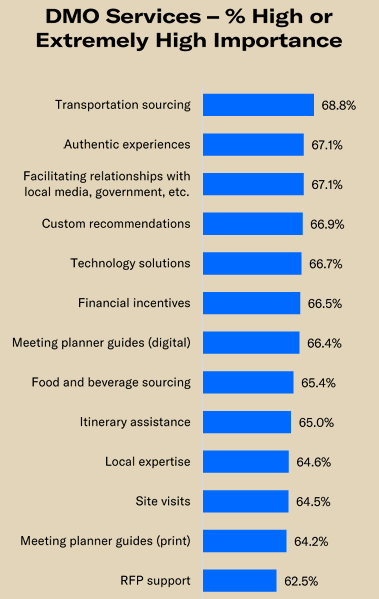
Nearly 70% of planners now use AI tools like ChatGPT to source meetings destinations, from planning logistics to fine-tuning shortlists. But here's the part that should reassure every DMO team: Planners who use AI are not replacing DMO services with new tech; they're using it to supplement the all-important information they get from the DMO. The study found that AI-using planners rated DMO services as more important than non-AI users across nearly every category, including transportation sourcing (71.2% vs. 65.6%), financial incentives (68.8% vs. 62.7%) and RFP support (65.5% vs. 59.4%). This may be because they know that AI tools rely on accurate, up-to-date information from established sources of truth, like a DMO's website.
When planners automate the routine work, their expectations for human partnership don't shrink, they grow. As panelist Dahlia El Gazzar of DAHLIA+Agency put it, we need to embrace being “the human in the loop”—the strategist and experience designer working alongside planners, not just the information desk sharing answers that an AI tool can easily provide.
This leads to questions worth asking for any DMO team: How are you spending your time? What tasks could be streamlined and still deliver standard information? And how can DMOs reinvest those hours into having the deep conversations with planners that hold more value? Because as AI compresses lead cycles, the quality of those human moments is what planners will remember.
The opportunity for DMOs is twofold:
- Optimize your website content for both search engines and AI tools so your destination shows up when planners run queries.
- Invest even more deeply in the relationship-driven work that AI simply can't replicate.
Looking Ahead
This study makes three things clear:
- Safety and values alignment are non-negotiables in site selection.
- Second- and third-tier destinations have a rising opportunity to capture market share.
- Real human connection matters more than ever in an AI-driven world.
What ties all of this together is that meeting planners aren't asking DMOs for more flash—they're asking for more substance. That means proactive communication around safety, storytelling that corrects perception gaps before they take root and deeper relationships that go beyond the standard pitch. The destinations that stand out in this environment will be the ones that treat every planner interaction as an opportunity to build trust, not just close a deal.
We encourage you to explore our full presentation with Future Partners, and if you’re thinking about what these shifts mean for your destination, let’s start that conversation together.